
RECAP: Get the Most Out of Audio Post to Elevate Your Storytelling

Four panelists gather at ATLFF 50's Creative Conference to discuss the importance of audio in filmmaking
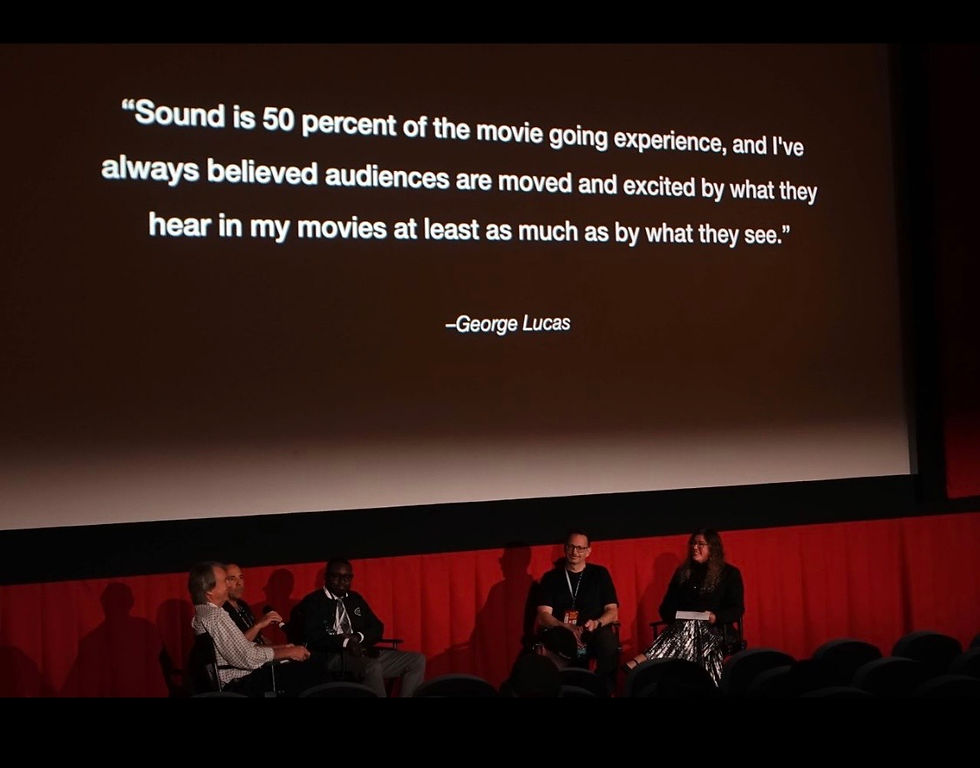
Filmmakers, editors and sound engineers filled the Jack Auditorium at the Tara Theater this week during the Atlanta Film Festival to learn about audio from four seasoned veterans, with over a hundred years of experience combined.
Elise Riley, CEO and founder of My Global Presence, served as moderator and host. The panelists included:
Chris Basta, founder of Atlanta’s BOOM Post Audio
Greg Crawford, an ADR mixer, sound supervisor, designer and re-recording mixer
DeLaVanta “Del” Tabor, a supervising sound editor
Michael Cardillo, a re-recording mixer and supervising sound editor

Sound quality can often be treated as an afterthought for TV and film. Unless you're an audiophile, one may consider sound to be only important for post-production, instead of the entire filmmaking process. "It's really important to have good sound because it's been proven that people can stomach bad video, as long as the audio's good," Tabor said. "They can sit through something enough to watch it. But if the audio's bad, they will leave."
Sound creates the environment and movement in a film, really pulling an audience into the scene, as if they were in it themselves. If you let it, sound can be truly transforming and a key storytelling tool. The medium is very important to create a memorable, connective film, according to Basta. "I've seen people cry [and come out of their seats]," he said. "That's the culmination of what we do, your story needs to have an emotional tie."
Communication and Collaboration
All four panelists emphasized the importance of including the sound team on day one, including location scouting. To go above and beyond the “zero line,” filmmakers are encouraged to talk about what they want the sound team to think about through the whole process. "If you can get your sound post audio team involved earlier, the process is already streamlined to help you maximize your budget going into that," Basta explained.
"We want to be a part of the conversation on the front end so that we're not chasing our tails on the back end," Cardillo agreed.
Budgeting Time and Money
Tabor included both time and money as crucial when it comes to a client's budget. Thinking ahead of the process keeps both sound and production on good terms throughout the process, whether it's an indie film, theatrical, or streaming. "Get someone involved early," Basta advised. "If you have a really good sound team that knows what you want. That will save you hours and hours. You're going to speed your process along so much in the film process."
"So are you saying that the proper four minutes on set could save you four hours in post?" Cardillo asked cheekily.
"I'm saying it even more," Basta emphasized.

Final Takeaways
Before opening up the theater floor for questions, Riley asked the panelists if they had any parting thoughts. Crawford talked about the amount of trust that directors like Steven Spielberg had with their team: "Knowing where to include us into the process is like 90% of the solution because you're hiring people to do what you do.”
Basta continued to emphasize the importance of getting an emotional response from your audience through the power of sound. He shared concern about the film industry in Georgia because of the loss of the tax benefit and AI. However, he encouraged audience members to keep going, no matter how small the budget is in indie films. "I've done so many movies where we gotta get it out, and we have so much potential of the scene,” he explained, referring to an example scene. “If we just drop the music and lean on just her breaths, that's the moment. It's painful to me, as an artist, to watch that and walk out without having an opportunity to present that and put it on the table for a client."
Next, Tabor hoped for audience members to see the bigger picture. "[I'm] hoping that everybody takes away more consideration for audio and more understanding of what it takes and all the moving parts that are required," he said. "Even if you hire just me for a project, you may not realize that there's five other people behind me that are actually doing stuff to make sure we meet your deadline."
Lastly, Cardillo honed in on the importance of teamwork. "We are already a unique breed," he shared. "We go through life listening to the world around us differently than the rest of you, and that's okay. We are part of a team. When you make your film and you're passionate about it and it's your baby, at some point, it becomes a team sport, you know? You’ve gotta let go of certain things. Make it a team sport and just value audio, from the beginning, all the way through. [Like] Chris said, no matter what your budget is, you can't say, 'Oh, I can't have audio because I can't afford it.' Bring somebody on to help you with your audio and figure it out."
The Final Question
There was only time for one question from the audience, regarding which traits the panelists would look for in hiring someone. Right off the bat, Basta wants someone who can bring something to the table. "If you're passionate—and you can tell very quickly if someone's just hitting a button—you can tell very quickly if someone's passionate about what they do," he pointed out. "To me, it's more about bringing something to the table, sharing something, being excited about it, and pushing the project forward. It is a team effort. Are we going up from zero or are we just going to hand him zero? Because zero doesn't work for me.”
Crawford, who noted that he’s done a lot of movies for free, said it's been in his DNA. He emphasized the importance of getting it done, no matter the budget. "That's exactly what you want people to really want to rock it more than the average person," he explained. "And secondly, you know, I think we all have seen this similar attitude amongst people in our profession—I always tell people, I was not the best engineer or technician, but I leapt and balanced, but I knew how to deal with people. It's an artistic endeavor. That's why we do this."
Tabor emphasized the importance of feedback and asking questions for improvement. "I need to know how I did, what was wrong, what were the problems on our end. The first time I did some dialogue editing for Chris [Basta], I didn't hear back, so I emailed him, like, 'Hey, what's up?' He's like, everything's fine. I like people like that who come back. Even if I don't have the time, they say, 'Hey, what can I do that's better? What did you like, what didn't you like?”
Lastly, Cardillo ended with a reminder of the importance of teamwork. “When you're making a film, it's not a product, it's people," he said. "If you want to be a filmmaker, it can't be your film. You have to share it with the people who are making it with you, and at some point, you turn it over to the audience. It's everybody's film. It's not a product, it's people."


